The SpaceX IPO could become one of the biggest market events of 2026, giving traders direct exposure to Elon Musk’s space, satellite internet and AI infrastructure ambitions in a single stock.
For years, SpaceX has been one of the world’s most watched private companies. Investors could follow its rocket launches, track Starlink’s global expansion and watch Elon Musk’s Mars vision unfold, but they could not easily trade SpaceX directly on public markets.
That may be about to change.
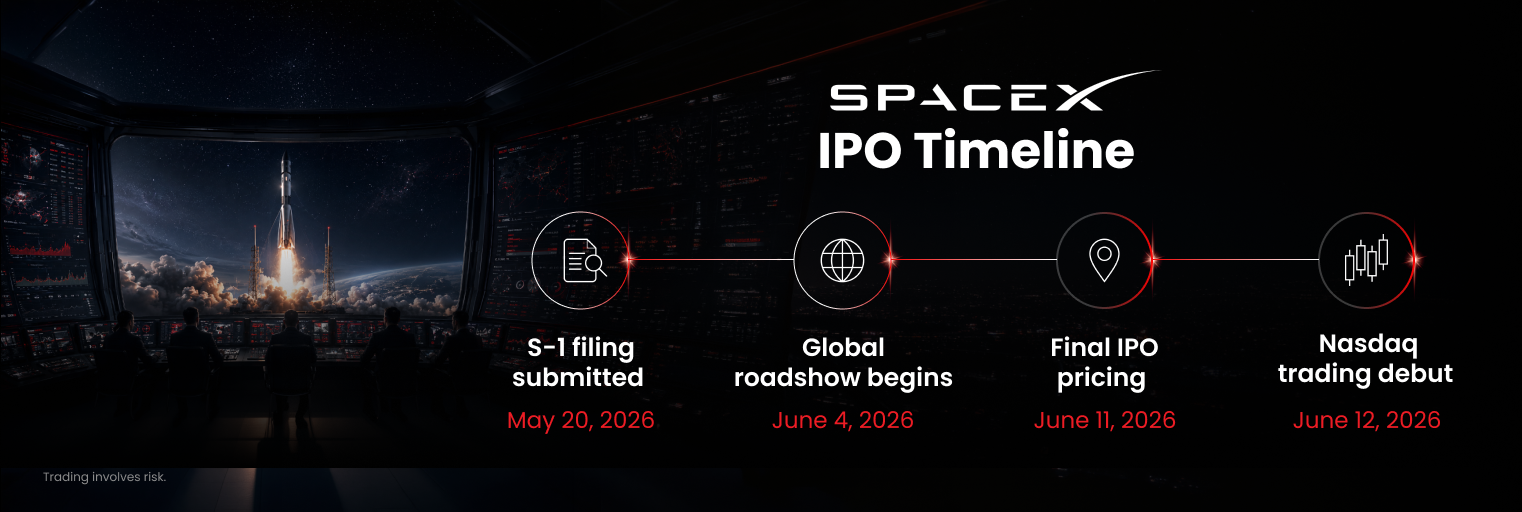
On May 20, 2026, SpaceX officially filed its S-1 registration statement with the US Securities and Exchange Commission (SEC), opening the door to what could become one of the largest initial public offerings (IPOs) in history.
The numbers are huge. The market attention may be even bigger.
But this IPO is not just about rockets. It is about Starlink’s recurring revenue, Starship’s cost-cutting potential, AI infrastructure, index demand and one of the most ambitious valuations Wall Street has ever seen.
Here are six key things traders should know before SpaceX starts trading.
1. SpaceX IPO Timeline, Valuation and Ticker
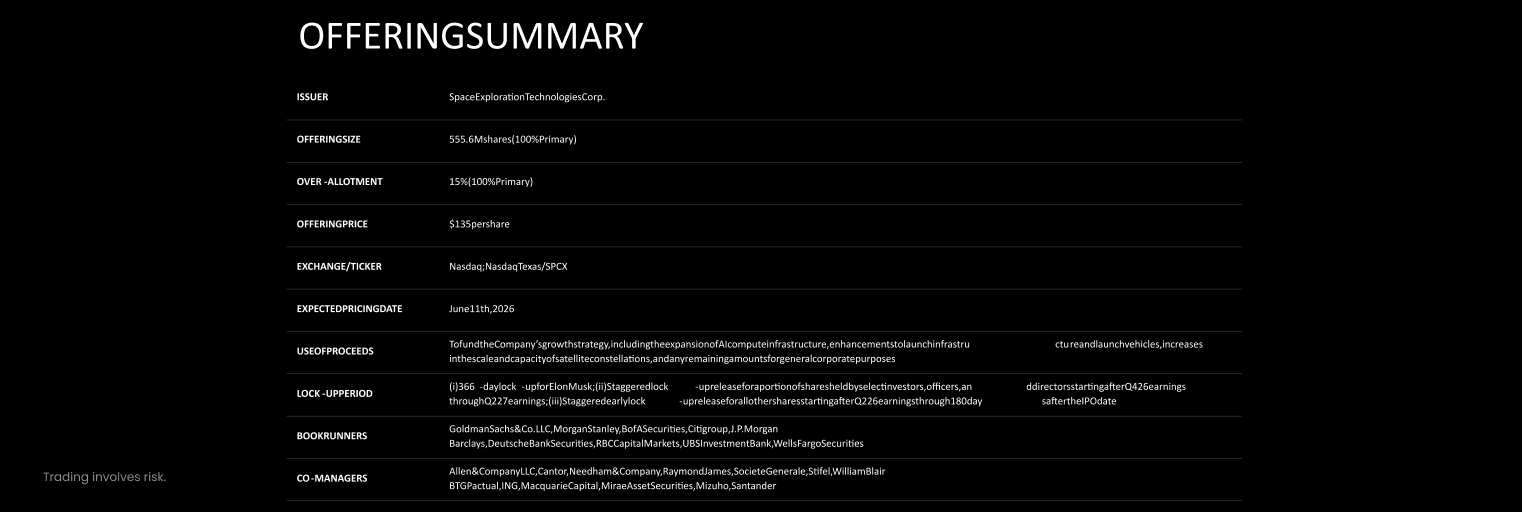
Image source: SpaceX IPO Roadshow
SpaceX is expected to list on the Nasdaq Stock Market under the ticker SPCX.
According to its IPO documents and market reports, SpaceX is targeting an expected fundraising size of around USD 75 billion, with an estimated valuation between USD 1.75 trillion and USD 2 trillion. If completed, it could surpass Saudi Aramco’s 2019 IPO record and become the largest IPO in history.
SpaceX IPO Key Details
| Item | Details |
|---|---|
| Ticker | SPCX |
| Exchange | Nasdaq |
| Expected fundraising size | Around USD 75 billion |
| Estimated valuation | Around USD 1.75 trillion to USD 2 trillion |
| Reported IPO price | USD 135 per share |
| Reported shares offered | Around 555.6 million shares |
| Major underwriters | Goldman Sachs, Morgan Stanley, Bank of America, Citi, J.P. Morgan and 23 Wall Street investment banks |
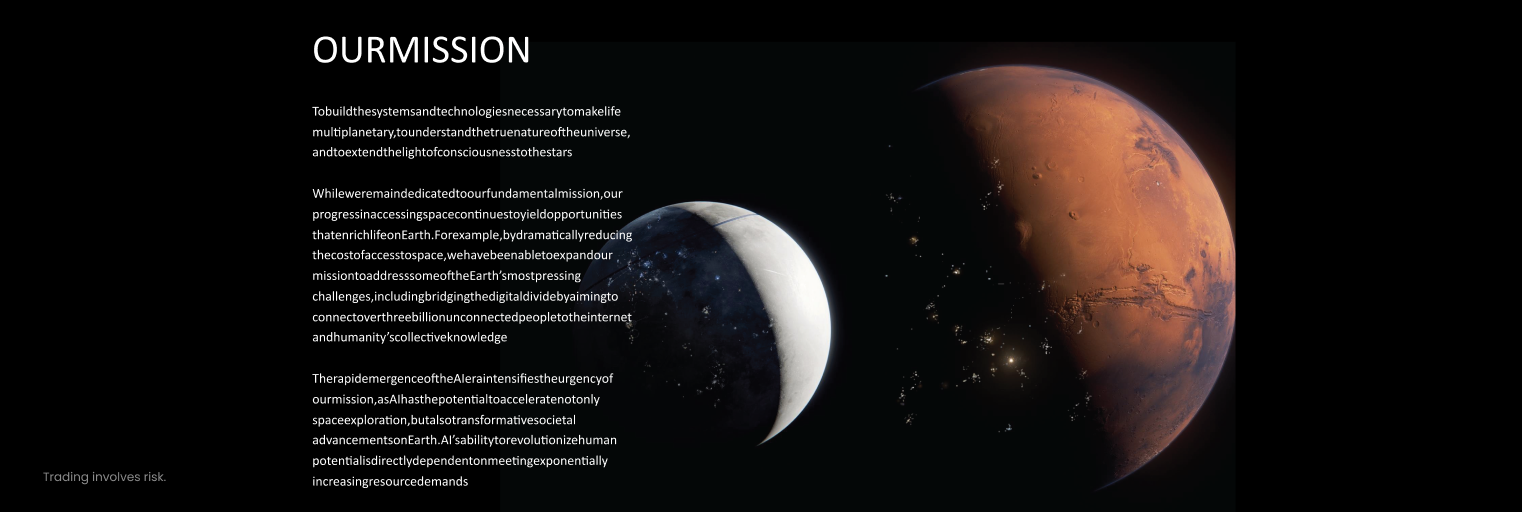
Image source: SpaceX IPO Roadshow
One factor that could make the SpaceX IPO especially volatile is its rare staggered lock-up structure.
Early investors may reportedly only be allowed to sell up to 20% of their shares from the second trading day after SpaceX releases its second-quarter earnings. Elon Musk and certain major investors are reportedly subject to a longer lock-up period of up to 366 days.
This matters because limited early share supply can amplify price swings if retail traders, institutional investors and passive funds all compete for exposure at the same time.
Index inclusion could also become a major catalyst. Nasdaq has reportedly introduced a faster inclusion mechanism for certain large newly listed companies, allowing eligible stocks to be considered after only 15 trading days. If SpaceX qualifies for major index inclusion, fund-flow demand could become an important post-IPO driver.
2. SpaceX Is More Than a Rocket Company
SpaceX is best known for rockets, but the IPO story goes far beyond launch services.
The company has evolved into a technology platform built around three major business segments: space transportation, satellite connectivity, and artificial intelligence.
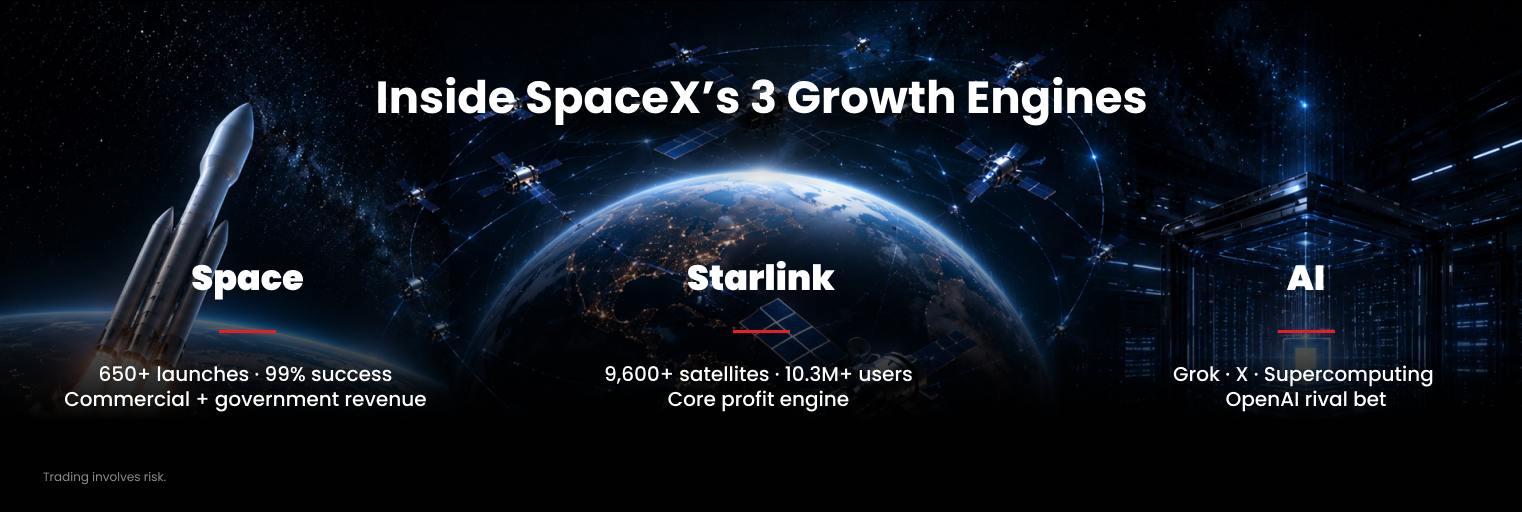
This combination gives SpaceX exposure to several major market themes at once: commercial space, global broadband, AI infrastructure and next-generation transportation.
For traders, that makes SpaceX more than a single-sector IPO. It is a multi-theme market story wrapped into one listing.
3. Why Starlink Is the Revenue Engine Wall Street Is Watching
Starlink may be the most important part of the SpaceX IPO story.
While rockets create the headlines, Starlink creates recurring revenue.
Its satellite internet network has already scaled across consumer, enterprise, aviation, maritime, government, and emerging market use cases.
For IPO investors, this is crucial. Starlink turns SpaceX from a long-term space vision into a company with a large and growing commercial business.
Why Starlink Matters
Starlink gives SpaceX exposure to:
- Remote internet users
- Enterprise communications
- Aviation Wi-Fi
- Maritime connectivity
- Government and defense-related connectivity
- Emerging market broadband access
The enterprise market is especially important. Through Starlink Aviation and Starlink Maritime, SpaceX is expanding into premium commercial use cases across air and sea.
Major companies such as Maersk, MSC, and Royal Caribbean have reportedly adopted Starlink connectivity for maritime operations. Airlines such as Hawaiian Airlines and Qatar Airways have also moved toward Starlink-powered in-flight Wi-Fi.
Enterprise customers can offer higher average revenue, stronger customer stickiness, lower churn, and lower price sensitivity. That makes Starlink one of the strongest pillars behind SpaceX’s premium valuation.
In 2025, Starlink reportedly generated more than USD 11.3 billion in revenue, supported by rapid subscriber growth and enterprise expansion.
4. SpaceX’s USD 28.5 Trillion Market Opportunity
In its prospectus, SpaceX describes its long-term opportunity as “the largest actionable total addressable market in human history,” with a potential market size of up to USD 28.5 trillion.
This figure goes far beyond rocket launches and satellite broadband. SpaceX is positioning itself across several future markets that could grow if space transportation costs continue to fall.
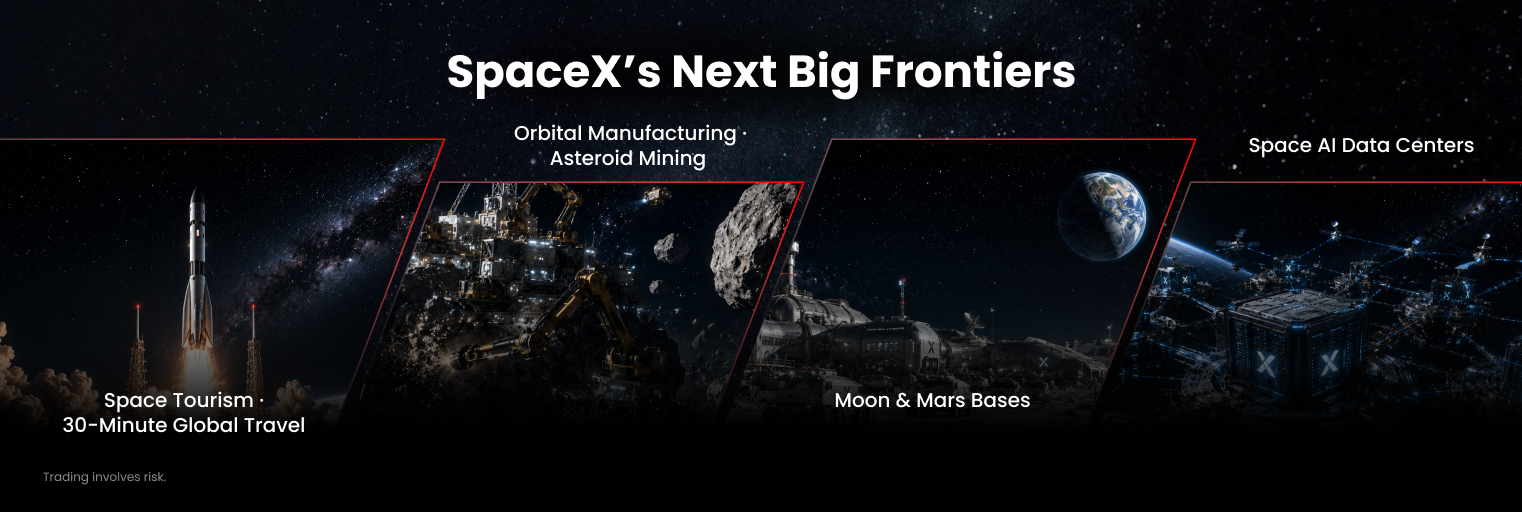
However, traders should treat this as a long-term vision, not a near-term earnings story. Many of these opportunities depend on two major assumptions: a sharp decline in the cost of reaching space and a major expansion in AI computing demand.
For now, investors may need to focus on more practical indicators, including Starlink subscriber growth, Starlink revenue, Starship testing progress and launch cost improvements.
5. Starship Could Make or Break the Valuation
Starship is central to SpaceX’s long-term valuation.
If successful, Starship could dramatically reduce the cost of reaching space, support faster Starlink deployment, enable deeper space missions, and open new commercial markets.
Without it, many of SpaceX’s most ambitious plans, including Mars settlement, low-cost satellite deployment, orbital manufacturing, and space-based data centers, may remain difficult to achieve.
SpaceX aims to reduce the cost of space access by more than 99%.
Space Launch Cost Comparison
| Launch System | Estimated Launch Cost |
|---|---|
| Historical average launch cost | Around USD 18,500 per kilogram |
| Falcon 9 | Around USD 2,700 per kilogram |
| Falcon Heavy | Around USD 1,400 per kilogram |
| Starship long-term target | Below USD 140 per kilogram |
SpaceX has reportedly invested more than USD 15 billion into Starship research and development.
That creates both upside and risk.
Successful Starship commercialization could strengthen SpaceX’s cost advantage and support its premium valuation. However, serious delays, technical setbacks, or regulatory challenges could force investors to reassess the stock.
The expected commercial debut of Starship in the second half of 2026 will therefore be one of the most important catalysts to watch.
6. SpaceX IPO Risks Traders Should Not Ignore
The SpaceX IPO offers exposure to some of the most exciting growth themes in global markets, but the risks are just as important.
Bullish Case for SpaceX
Starlink has real cash-flow potential
Starlink has already shown that SpaceX can turn satellite infrastructure into a large commercial business. Its 2025 revenue reportedly exceeded USD 11.3 billion, supported by rapid user growth and enterprise adoption.
Starship could create a major cost advantage
If Starship reaches full commercialization, SpaceX could deploy satellites more cheaply, scale Starlink faster, and challenge traditional aerospace companies.
SpaceX has one of the strongest market narratives
Commercial space, AI, satellite connectivity, and Elon Musk’s Mars vision give SpaceX a story few companies can match.
Key Risks for SpaceX
Valuation risk
A valuation near USD 1.75 trillion implies extremely high expectations. At around 94 times price-to-sales, SpaceX may have little room for disappointment if growth slows or profitability misses expectations.
Starship execution risk
If Starship cannot achieve full reusability, the cost-reduction story weakens and the valuation could come under pressure.
AI cash-burn risk
AI creates long-term upside, but competing with Google, Microsoft, OpenAI, Meta, Amazon, and other major players requires heavy spending.
Elon Musk dependency risk
SpaceX is closely tied to Musk’s leadership and public image. Regulatory disputes, legal issues, management distractions, or controversial comments could affect market sentiment.
Post-IPO volatility risk
Limited float, lock-up rules, retail demand and possible index inclusion could amplify short-term price swings after listing.
A Long-Term Bet on the Future of Space
One of the most important lines in the S-1 filing is SpaceX’s mission statement: “to make humanity multiplanetary.”
Investing in SpaceX is essentially buying into a 10-to-20-year bet on the future of human civilization. As Elon Musk has said, humanity should not end up like the dinosaurs.
For investors who dare to dream and can withstand extreme volatility, SpaceX may become one of the most exciting investment opportunities of this era.
But for traders, the key is not just the story. It is knowing which catalysts can move the stock after listing.
Trade the SpaceX Opportunity with D Prime
As SpaceX heads toward its historic Nasdaq debut, D Prime will launch SPCXUSD on MT5 on June 12, giving clients access to one of 2026’s most anticipated market events.
From commercial space and AI infrastructure to potential post-listing volatility, SpaceX could be a stock traders watch closely from day one.
With D Prime, you can trade SPCXUSD in a fast, flexible environment with deep liquidity and access to global market opportunities in one platform.
Log in or open a D Prime MT5 account and get ready for the SpaceX IPO.
Stay ahead of the markets with D Prime Market Dive and follow the D Prime Media Center for the latest updates and trading opportunities.
By D Prime Analysis Team
Macro and market strategy research by D Prime’s in-house analysis team.
Risk Disclosure
Trading in Securities, Futures, contracts for difference (CFDs) and other financial products carries high risks due to the rapid and unpredictable fluctuation in the value and prices of these financial instruments. This unpredictability is due to the adverse and unpredictable market movements, geopolitical events, economic data releases, and other unforeseen circumstances. You may sustain substantial losses, including losses exceeding your initial investment within a short period of time.
You are strongly advised to fully understand the nature and inherent risks of trading with the respective financial instrument before engaging in any transactions with us. When you engage in transactions with us, you acknowledge that you are aware of and accept these risks.
Disclaimer
The information contained herein is provided for general informational and educational purposes only and does not constitute investment advice, financial advice, trading advice or any other form of professional advice, a recommendation, or an offer or solicitation to buy or sell any financial instruments or engage in any trading strategy.
Trading in leveraged products such as contracts for difference (CFDs) involves a significant risk of loss and may not be suitable for all investors. Past performance is not indicative of future results. Any references to market trends, asset performance, price levels, or forward-looking statements reflect opinions or general market commentary as at the date of publication and are subject to change without notice.
This article does not take into account any individual investor’s objectives, financial situation, or risk tolerance. Readers should conduct their own independent research and seek professional advice before making any investment or trading decisions. D Prime and its affiliates make no representations or warranties about the accuracy or completeness or reliability of this information and disclaim any and all liability for any direct, indirect, incidental, consequential, or other losses or damages arising out of or in connection with the use of or reliance on any information contained herein. The above information should not be used or considered as the basis for any trading decisions or as an invitation to engage in any transaction. Do not rely on this article to replace your independent judgment.
“D Prime” is a brand name of D Prime Vanuatu Limited, a company incorporated and regulated by the Vanuatu Financial Services Commission (Company Number: 700238). The availability of products and services may vary depending on jurisdiction and applicable regulatory requirements.