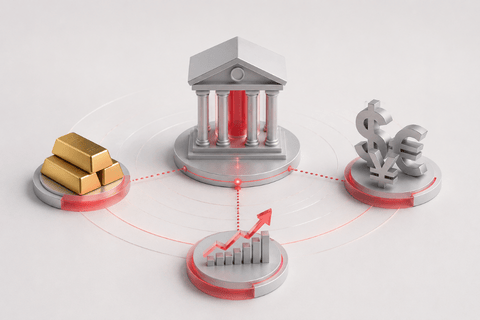


Dxpert explores how interest rate expectations shape forex, gold, and indices, and why markets often move before the official rate decision.
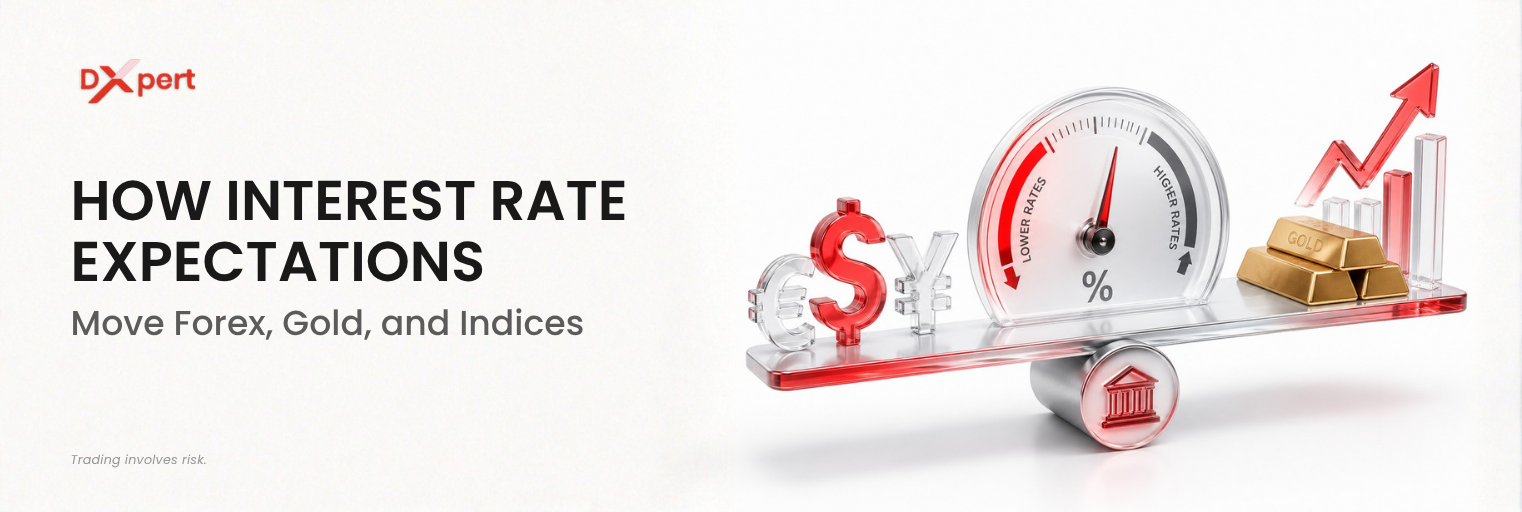
Every trader has seen it happen! A central bank cuts interest rates, exactly as the headlines expected, yet the currency rallies instead of falling. Or a central bank delivers a hawkish statement, suggesting rates may stay higher for longer to fight inflation and gold holds firm or even climbs.
At first glance, it can look confusing. If you only read the headline, the market reaction may seem completely strange.
But it is not strange at all. It is one of the most important patterns in trading.
Markets do not simply trade the rate decision itself. They trade the surprise. And that surprise is measured against what the market had already expected, not just against the previous interest rate.
Why Markets Price In Interest Rate Expectations
Financial markets are forward-looking. By the time a central bank, such as the Federal Reserve in the US, the European Central Bank in the Eurozone, or the Bank of England in the UK, announces its decision, traders and institutions have usually spent weeks preparing for the most likely outcome.
They use tools such as interest rate futures to estimate where rates may be in the future. As a result, a large amount of buying and selling often happens before the announcement is even made.
This is what traders mean when they say something is “priced in.”
If the decision matches what the market already expected, there may be little left to react to. The bigger move usually comes from the difference between what happened and what was expected.
Just as important is forward guidance. This is the language central banks use to signal what may happen at future meetings. A rate hold with hints of future cuts can move markets more than an actual cut that everyone already expected.
That is the logic behind the phrase “buy the rumor, sell the fact.” Markets often move in anticipation of an event, while the event itself becomes a moment of confirmation, disappointment, or repricing.
How Central Bank Expectations Can Reprice Markets
Think of any period when traders were debating whether a central bank was about to pivot, meaning whether it would stop raising rates or begin cutting them.
During these periods, forex pairs, gold, and stock indices often move more sharply on a single sentence from a central bank press conference than on the official rate decision itself.
For example, a phrase such as “rate cuts are not yet appropriate” or “policy easing may be closer than expected” can immediately change how traders view the future path of interest rates.
That is expectations repricing in real time.
The market is not only reacting to what changed today. It is reacting to what today’s message means for the next several months.
How Interest Rate Expectations Affect Forex
In forex, currencies are driven by relative expectations.
A currency does not strengthen simply because interest rates are high. It tends to strengthen when rates are expected to stay high, or rise further, compared with another currency.
This is the idea behind the carry trade, where traders borrow in a low-interest-rate currency and invest in a higher-interest-rate currency to benefit from the difference.
So, if the market suddenly believes a central bank may cut rates sooner than expected, that currency can weaken immediately, even if the actual rate has not changed yet.
The key question is not just, “Are rates high?”
The better question is, “Are rates expected to remain higher than the other currency in the pair?”
How Interest Rate Expectations Affect Gold
Gold is often sensitive to real interest rate expectations.
A real interest rate is the interest rate after inflation is taken into account. It gives traders a better sense of the true return they may earn from holding interest-paying assets.
Gold does not pay interest. Because of that, its appeal is often tied to opportunity cost — what traders give up by holding gold instead of an asset that pays interest.
When expected real rates fall, gold usually becomes more attractive because the cost of holding it is lower.
This is why gold can rise after a rate hold if the central bank sounds dovish, meaning it hints at future cuts or easier policy. It is also why gold can fall even after an actual rate cut if the central bank suggests that the cut is temporary or not the beginning of a longer easing cycle.
For gold traders, the headline decision matters, but the expected path of real rates matters more.
How Interest Rate Expectations Affect Stock Indices
Stock indices, such as the S&P 500, Nasdaq 100, or FTSE 100, also react strongly to interest rate expectations.
Lower expected future rates can support stock markets in several ways. When rates are expected to fall, investors tend to value future company profits more highly because those profits are discounted less heavily. In simple terms, future earnings look more valuable today. This can help lift stock valuations, especially for growth companies whose profits are expected further down the road.
Lower expected rates can also make bonds less attractive compared with stocks and reduce borrowing costs for businesses and consumers.
This is why stock indices can sometimes rally on economic data that appears weak at first glance. A softer jobs report, for example, may raise expectations for future rate cuts.
The market is not celebrating economic weakness. It is repricing the future cost of capital, in other words, how cheap or expensive it may be for businesses to borrow, invest, and grow.
Why Interest Rate Expectations Matter to Traders
Understanding expectations can completely change the way you approach high-impact economic events.
The headline number is only part of the story. What matters just as much is how that number compares with what the market had already priced in.
Forward guidance can be even more powerful than the decision itself. A press conference, statement, or small change in language can shift expectations for the next several meetings.
In forex, traders should focus on the gap between two currencies’ expected rate paths, not just the level of one country’s interest rate.
In gold, the focus should be on real interest rate expectations, not simply whether a central bank cut, hiked, or held rates.
In stock indices, traders need to remember that markets price the future. Data that looks negative today can still support stocks if it increases expectations for lower rates ahead.
Key Takeaways on Interest Rate Expectations
Markets often move before the news even comes out because traders have already positioned themselves for what they expect the outcome to be. The real action happens when reality does not match that expectation.
That is why central bank statements and forward guidance can sometimes move the market more than the rate decision itself. Traders are not only watching what the central bank did today. They are trying to understand what it may do next.
- Forex responds to relative interest rate expectations between two currencies, not absolute rate levels.
- Gold is influenced by real interest rate expectations and opportunity cost.
- Stock indices react to changes in future earnings expectations, borrowing costs, and the discount rate.
Learning to read expectations rather than headlines is one of the most valuable skills a trader can develop.
Before trading any high-impact event, have a clear plan, use sensible position sizing, and manage your risk carefully. Markets driven by shifting expectations can move quickly in both directions, and protecting your capital should always come first.
By Andreas Thalassinos, Head of Trading Insights at Dxpert
Disclaimer
Any views, opinions, analyses, or statements provided by third parties are for informational purposes only and represent the personal views of the respective third parties. They do not constitute or represent the views, recommendations, or official position of D Prime. D Prime does not verify, endorse, or accept responsibility for the accuracy, completeness, or reliability of such content.
The information contained herein is provided for general informational and educational purposes only and does not constitute investment advice, financial advice, trading advice or any other form of professional advice, a recommendation, or an offer or solicitation to buy or sell any financial instruments or engage in any trading strategy.
Trading in leveraged products such as contracts for difference (CFDs) involves a significant risk of loss and may not be suitable for all investors. Past performance is not indicative of future results. Any references to market trends, asset performance, price levels, or forward-looking statements reflect opinions or general market commentary as at the date of publication and are subject to change without notice.
This article does not take into account any individual investor’s objectives, financial situation, or risk tolerance. Readers should conduct their own independent research and seek professional advice before making any investment or trading decisions. D Prime and its affiliates make no representations or warranties about the accuracy or completeness or reliability of this information and disclaim any and all liability for any direct, indirect, incidental, consequential, or other losses or damages arising out of or in connection with the use of or reliance on any information contained herein. The above information should not be used or considered as the basis for any trading decisions or as an invitation to engage in any transaction. Do not rely on this article to replace your independent judgment.
“D Prime” is a brand name of D Prime Vanuatu Limited, a company incorporated and regulated by the Vanuatu Financial Services Commission (Company Number: 700238). The availability of products and services may vary depending on jurisdiction and applicable regulatory requirements.