


Dxpert explores how central banks, interest rates, real yields and policy guidance influence gold, forex and stock indices.
Central banks are among the strongest forces shaping global financial markets. Their decisions affect interest rates, borrowing costs, currencies, liquidity, inflation expectations, and investor sentiment.
For traders, the key point is that markets react not only to what a central bank does, but also to how that decision compares with expectations. A rate hike that is fully expected may have little impact, while a small shift in guidance can trigger sharp moves across gold, foreign exchange, and stock indices.
Understanding these relationships helps traders interpret market moves without relying on rigid assumptions, such as higher rates always being negative for stocks or lower rates inevitably pushing gold higher.
How Central Bank Monetary Policy Affects Financial Markets
When a central bank changes interest rates, buys or sells assets, or signals that a policy shift may be coming, traders reassess where rates may be headed. Those expectations can then influence bond prices, currencies, stocks, other investments, and eventually the wider economy.
The process often looks like this:
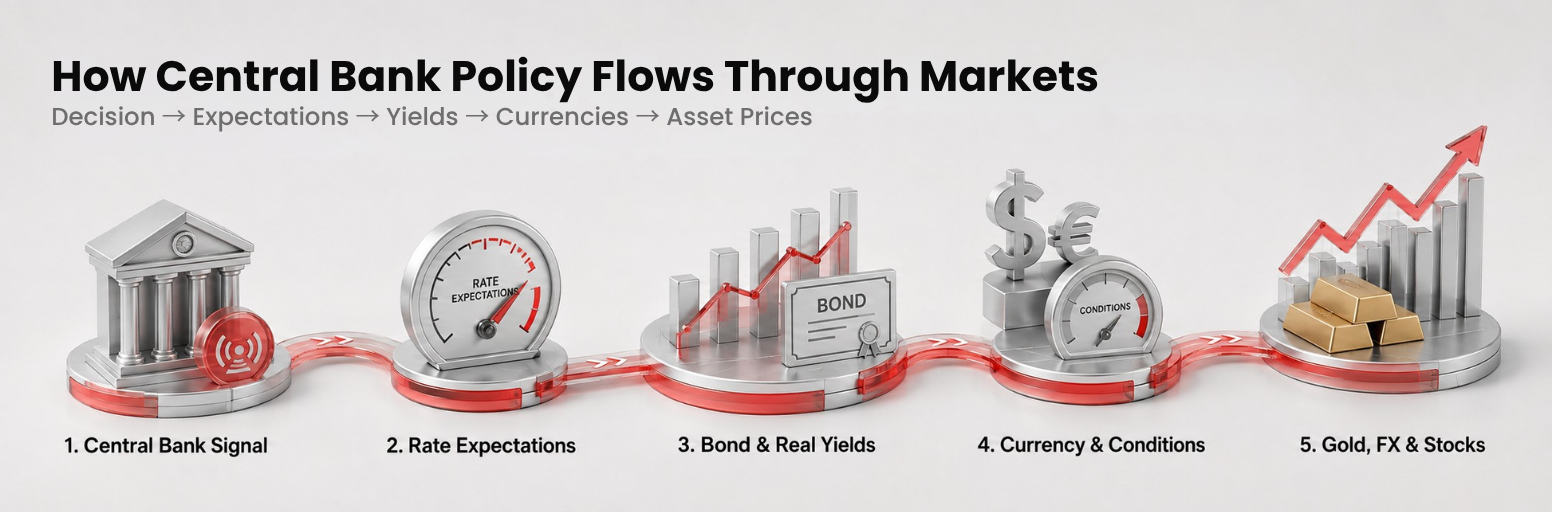
- 1. The central bank changes policy or signals a possible change.
- 2. Traders adjust interest rate expectations.
- 3. Bond yields and real yields respond.
- 4. Currencies and broader financial conditions move.
- 5. Gold, stocks, and other assets are repriced.
This is why one central bank meeting can affect several markets at the same time.
How Central Bank Forward Guidance Moves Markets
Central banks influence markets through communication as well as policy action.
Forward guidance refers to what policymakers communicate about the likely future direction of monetary policy. Investors closely monitor official statements, economic projections, press conferences and speeches because financial markets are forward looking.
A central bank can therefore leave interest rates unchanged and still cause a significant market reaction.
For example, if policymakers say inflation remains too high and rate cuts are unlikely in the near future, bond yields may rise, the currency may strengthen and stock indices may come under pressure.
Central bank communication is often described as:
- Hawkish guidance: Policy is tighter, or expected to remain tighter, than markets anticipated.
- Dovish guidance: Policy is easier, or expected to become easier, than markets anticipated.
- Neutral guidance: Policy is broadly in line with market expectations.
The gap between what markets expected and what policymakers actually communicated can sometimes matter more than the headline rate decision itself.
How Central Banks Policies Affect Gold Prices
Gold is particularly sensitive to interest rates because it does not pay interest or dividends, creating an opportunity cost relationship.
When real yields rise, interest bearing assets can become more attractive compared with gold. When real yields fall, the relative cost of holding gold decreases.
In simplified terms:
- Rising real yields can pressure gold.
- Falling real yields can support gold.
- Safe haven demand can still support gold even when yields are rising.
Gold is also closely linked to the US dollar because it is commonly priced in dollars. A stronger dollar can make gold more expensive for buyers using other currencies, while a weaker dollar can make it relatively cheaper.
A dovish Federal Reserve can therefore support gold through two channels: lower expected real yields and a weaker US dollar.
Still, the relationship is not automatic. Gold can also be influenced by geopolitical risk, inflation expectations, financial stress, and safe haven flows.
How Central Banks Affect Forex Markets
Foreign exchange is based on relative value, so traders usually compare the policy outlook of two central banks rather than looking at one country in isolation.
For example, if markets expect the Federal Reserve to keep rates high while the European Central Bank is expected to cut, the interest rate differential may support the U.S. dollar against the euro. If those expectations shift, the currency pair may move the other way.
FX traders often monitor:
- Interest rate differentials.
- Expected future rate paths.
- Inflation and employment data.
- Central bank communication.
- Economic growth.
- Risk sentiment.
- Balance sheet policy.
Reactions can also appear counterintuitive. A central bank may cut rates, but its currency could rise if traders had expected a larger cut. Likewise, a rate hike may fail to support a currency if markets believe the move will damage growth or if policymakers suggest that the tightening cycle is almost over.
In FX, expectations and relative policy are critical.
How Interest Rates Affect Stock Indices
Stock indices are influenced by company valuations, profit expectations, market liquidity, and investors’ willingness to take on risk.
A key factor is the discount rate. Share prices are partly based on what investors think future earnings are worth today. When rates rise, those future earnings are discounted more heavily, lowering their present value. As a result, company valuations and broader stock indices may come under pressure.
Growth oriented stocks can be especially sensitive because more of their expected value may lie further in the future.
Higher rates can also slow credit growth, consumer spending, and business investment, weakening corporate earnings expectations. Lower rates may support markets by reducing financing costs and improving liquidity.
Again, the reason for the rate move matters. If rates fall because inflation is easing while growth remains stable, stocks may benefit. If they fall because the economy is deteriorating sharply, investors may focus instead on weaker earnings and recession risk.
How Quantitative Easing and QT Affect Markets
Central banks can also influence financial markets through their balance sheets.
Under quantitative easing, or QE, a central bank buys assets such as government bonds. These purchases can help lower longer term yields, increase liquidity within the financial system and encourage some investors to move toward higher risk assets.
Quantitative tightening, or QT, works in the opposite direction by reducing the central bank’s balance sheet.
Balance sheet policy can influence:
- Government bond yields.
- Market liquidity.
- Credit conditions.
- Portfolio allocation.
- Risk premiums.
- Investor confidence.
This distinction is important because policy rates and balance sheet policy are separate tools.
A central bank may keep short term interest rates unchanged while continuing to reduce its balance sheet, which can still contribute to tighter financial conditions.
Inflation Targets and Market Expectations
Inflation targets play an important role in how markets interpret central bank policy.
When inflation remains above target, traders may expect interest rates to stay higher for longer. When inflation moves sustainably lower, markets may begin pricing in future rate cuts.
Central bank credibility also matters.
If investors believe policymakers remain committed to controlling inflation, longer term inflation expectations may remain relatively stable.
If that credibility weakens, bond yields and risk premiums may rise as investors demand greater compensation for uncertainty.
Example: A Hawkish Fed Hold
Suppose the Federal Reserve keeps rates unchanged. On its own, that may not seem significant. But the message changes if the Fed also warns that inflation remains too high and suggests there may be fewer rate cuts ahead than investors had expected.
That could produce a hawkish market reaction:
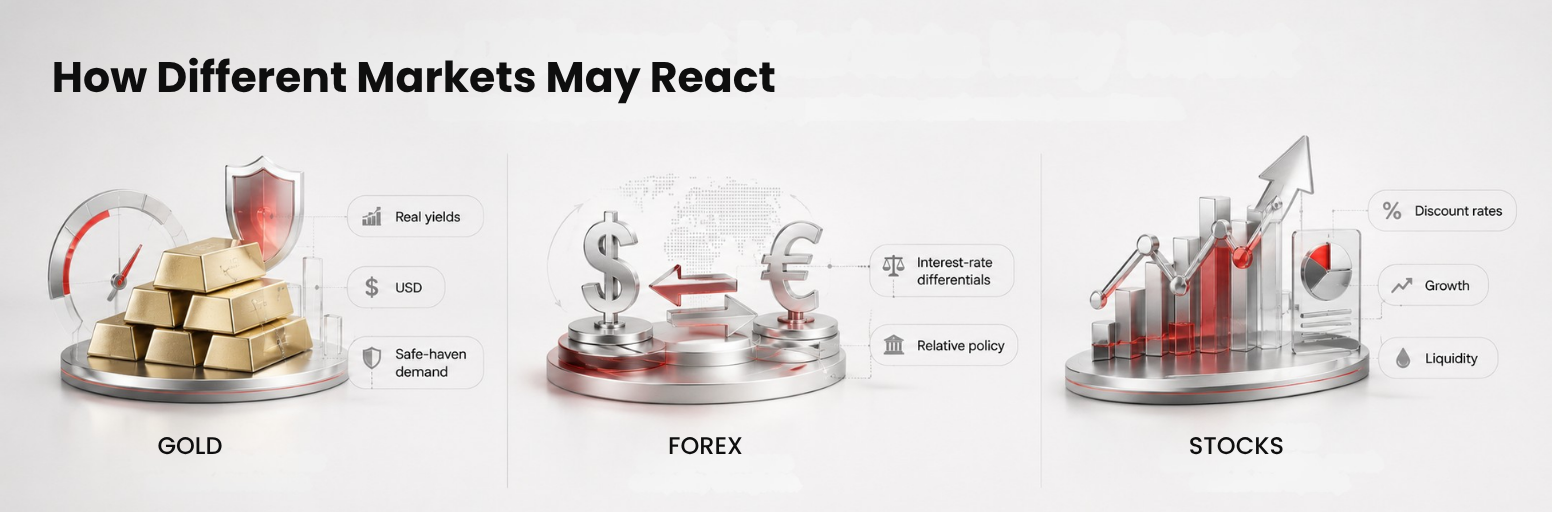
- Gold: May face pressure if real yields rise and the US dollar strengthens.
- FX: The US dollar may strengthen against currencies backed by more dovish central banks.
- Stock indices: Higher expected discount rates may put pressure on equity valuations.
At the same time, a positive assessment of economic growth could allow stocks to remain resilient or recover, particularly if investors become more confident about future company earnings.
This is why the idea that “higher rates always mean lower stock prices” is too simplistic.
Four Questions Traders Should Ask Around Central Bank Meetings
Around a central bank event, traders can focus on four questions:
Four questions can help:
- 1. What was the market expecting?
- 2. What changed in the expected future path of interest rates?
- 3. How did bond yields and real yields react?
- 4. Is the market move being driven primarily by inflation, growth or risk sentiment?
Other signals to watch include expected interest rate moves, government bond yields, inflation adjusted yields, major FX markets, inflation expectations, central bank balance sheets, and sector level equity performance.
From Policy to Price Action
Central banks have a broad influence on financial markets because their decisions affect both the cost of capital and the amount of liquidity available within the financial system.
For gold, traders often monitor real yields, the US dollar and demand for defensive assets.
In forex markets, price movements are frequently influenced by differences in expected monetary policy between two economies and the resulting interest rate differentials.
Stock indices can react as monetary policy changes financing conditions, valuation assumptions, economic growth expectations, liquidity and investor confidence.
Most importantly, financial markets often react not simply to what a central bank does, but to the difference between what investors expected and what policymakers actually delivered.
Understanding these relationships cannot eliminate market uncertainty, but it can help traders interpret major price movements more systematically and assess the forces driving gold, FX and stock indices.
Stay informed with D Prime market insights and deepen your understanding of the forces shaping gold, forex and global indices.
By Andreas Thalassinos, Head of Trading Insights at Dxpert
Disclaimer
Any views, opinions, analyses, or statements provided by third parties are for informational purposes only and represent the personal views of the respective third parties. They do not constitute or represent the views, recommendations, or official position of D Prime. D Prime does not verify, endorse, or accept responsibility for the accuracy, completeness, or reliability of such content.
The information contained herein is provided for general informational and educational purposes only and does not constitute investment advice, financial advice, trading advice or any other form of professional advice, a recommendation, or an offer or solicitation to buy or sell any financial instruments or engage in any trading strategy.
Trading in leveraged products such as contracts for difference (CFDs) involves a significant risk of loss and may not be suitable for all investors. Past performance is not indicative of future results. Any references to market trends, asset performance, price levels, or forward-looking statements reflect opinions or general market commentary as at the date of publication and are subject to change without notice.
This article does not take into account any individual investor’s objectives, financial situation, or risk tolerance. Readers should conduct their own independent research and seek professional advice before making any investment or trading decisions. D Prime and its affiliates make no representations or warranties about the accuracy or completeness or reliability of this information and disclaim any and all liability for any direct, indirect, incidental, consequential, or other losses or damages arising out of or in connection with the use of or reliance on any information contained herein. The above information should not be used or considered as the basis for any trading decisions or as an invitation to engage in any transaction. Do not rely on this article to replace your independent judgment.
“D Prime” is a brand name of D Prime Vanuatu Limited, a company incorporated and regulated by the Vanuatu Financial Services Commission (Company Number: 700238). The availability of products and services may vary depending on jurisdiction and applicable regulatory requirements.