

Paper trading lets you test the market without putting real capital at risk. Live trading changes the equation.
The charts may look familiar. The platform may work the same way. You may even follow the exact strategy you practiced for weeks. But once real money enters the picture, execution conditions, trading costs, market volatility, and emotion can make the experience feel very different.
That gap is exactly why understanding paper trading vs live trading matters.
Rather than treating demo trading and live trading as two separate worlds, think of them as different environments with different purposes. One gives you room to learn, test, and build a process. The other puts that process into real market conditions where both gains and losses become real.
So, what exactly changes when you make the move?
Let’s break it down.
What is Paper Trading and How Does It Work?
While live trading means placing real trades with actual funds, the simulated version is essentially the opposite. So, what is paper trading?
Paper trading, also known as demo trading, allows you to practice buying and selling financial instruments using virtual funds in a simulated trading environment. Instead of risking your own capital, you can use a demo trading account to explore the platform, test ideas, practice order placement, and get familiar with how markets move.
For beginners, this makes paper trading a useful place to build the foundations.
You can learn how to open and close positions, experiment with different instruments, test your risk-management rules, and see how a strategy behaves without putting real money behind every decision.
But there is one important thing to remember: A trading simulator cannot recreate every part of live trading.
When analyzing paper trading vs live trading, the transition introduces several differences that can have a real impact on how you trade.
Paper Trading vs Live Trading: 4 Key Differences
Virtual Funds vs Real Capital
The most obvious difference is also one of the most important.
In paper trading, the money is virtual. A losing trade may affect your demo balance, but it does not reduce the money in your bank account. That gives you more freedom to test, make mistakes, and learn from them.
Live trading is different. Once you trade with real capital, every position carries the possibility of a real financial gain or loss. Suddenly, decisions that felt easy in a demo account can require much more discipline.
This is why the move to live trading should not simply be about asking: “Can I make money in demo?”
A better question is: “Can I consistently follow my process when real money is at risk?”
Simulated vs Live Execution
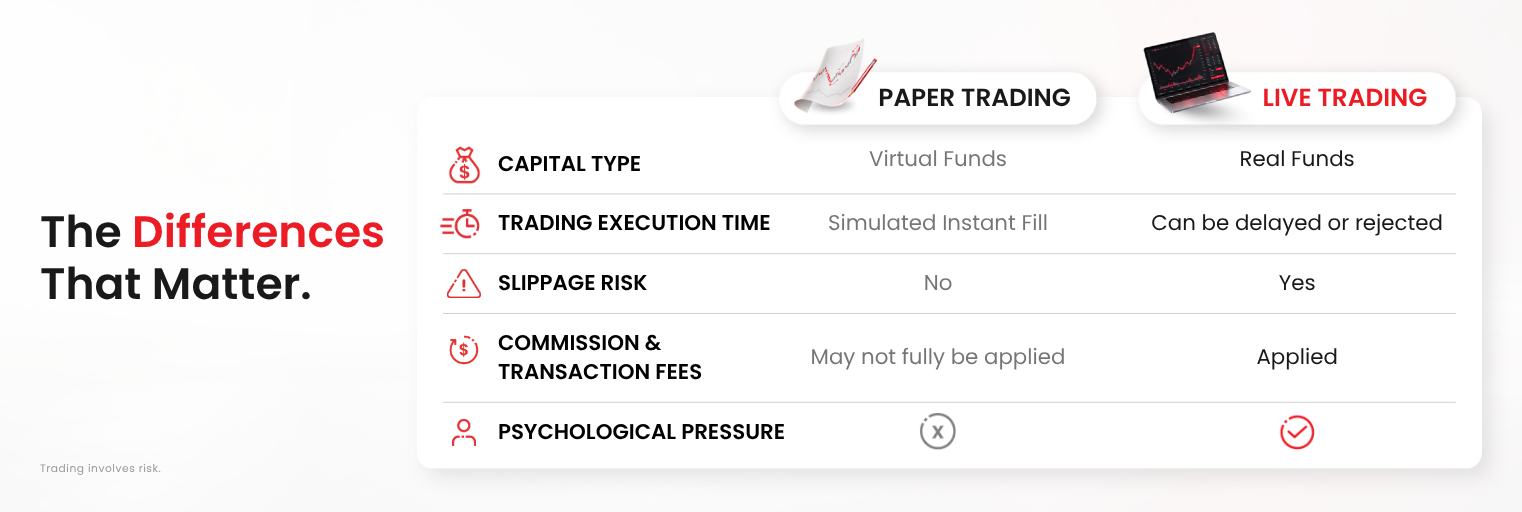
Demo and live accounts may display similar market prices, but execution conditions can differ. While paper trading is excellent for practicing the process of execution, live trading introduces the reality of executing within actual market conditions.
In a simulated environment, orders may not fully reflect every real-world factor affecting live execution, such as changing liquidity, slippage, partial fills, or execution delays.
Live markets move continuously. Between the moment you submit an order and the moment it is filled, the available market price can change, particularly during periods of high volatility or lower liquidity. That means your final execution price may sometimes differ from the price you saw when placing the trade.
Simulated Costs vs Real Trading Costs
A strategy can look very different once real trading costs are included.
Depending on the broker and demo environment, some spreads, commissions, and other costs may be simulated. However, demo conditions may not always reflect a live account exactly.
In live trading, actual spreads, commissions, and applicable transaction costs directly affect the outcome of each trade. A strategy that looks promising on paper should therefore be evaluated with these real-world costs in mind.
The takeaway?
Do not judge a strategy only by whether it generated a positive demo result. Understand what happens after execution costs are included too.
Practice Psychology vs Real Emotion
Virtual money changes how decisions feel.
A setup that seems easy to follow with a demo balance can feel very different when your own capital is involved.
- Fear may push you to close a position too early.
- Greed may tempt you to increase your exposure after a winning streak.
- FOMO can make a trade suddenly look irresistible, even when it does not fit the plan you spent weeks practicing.
This psychological gap is one of the biggest differences you will find when stepping out of a trading simulator.
The charts may be the same. Your reaction to them may not be.
How Do You Know When You’re Ready for Live Trading?
Using demo trading is usually treated as a testing ground to reach live trading with less confusion. This implies that you cannot rely on a demo trading account forever. At a later stage, it becomes necessary for you to switch from practice to reality. But when are you ready for live trading?
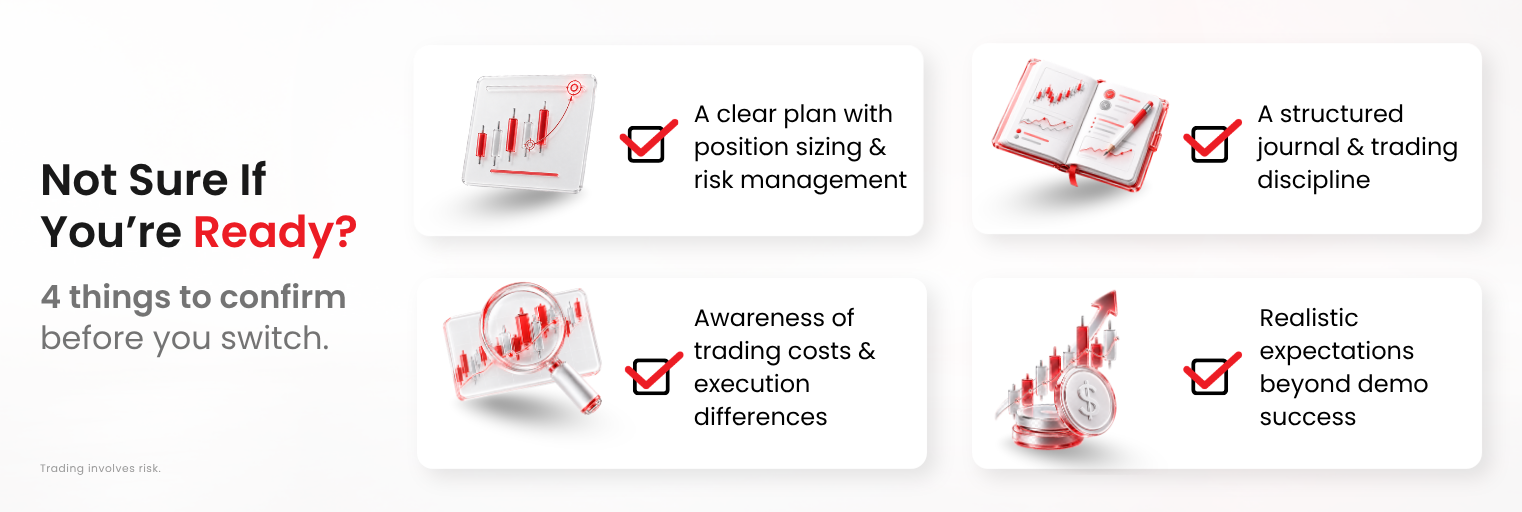
In fact, there is no universal point at which every trader suddenly becomes “ready”. And a few profitable weeks or months in a demo trading account do not automatically mean it is time to move to live trading.
Instead, look at the process behind your results, and be prepared for the next step when:
- You can follow a clear trading plan consistently: Your entries, exits, and risk rules are defined before you trade.
- You understand position sizing and risk management: You know how much you are prepared to risk and why.
- You keep a trading journal: You record your decisions and review what worked, what did not, and where your process broke down.
- You can follow your rules after a losing trade: One loss does not immediately push you into revenge trading or abandoning your strategy.
- You understand trading costs and execution differences: You know that live results may differ from demo results.
- You understand that demo success is not a guarantee: The goal is to build a repeatable process, not prove that every trade will work.
Remember, paper trading is not a test you “pass”.
It is a place to build habits you can carry with you when real capital enters the picture.
How to Gradually Move From Paper Trading to Live Trading?
Now that we have figured out when to switch, the next question you might ask is: How do I manage this transition smoothly and effectively?
Below is a short guide that we hope supports you during this switching journey:
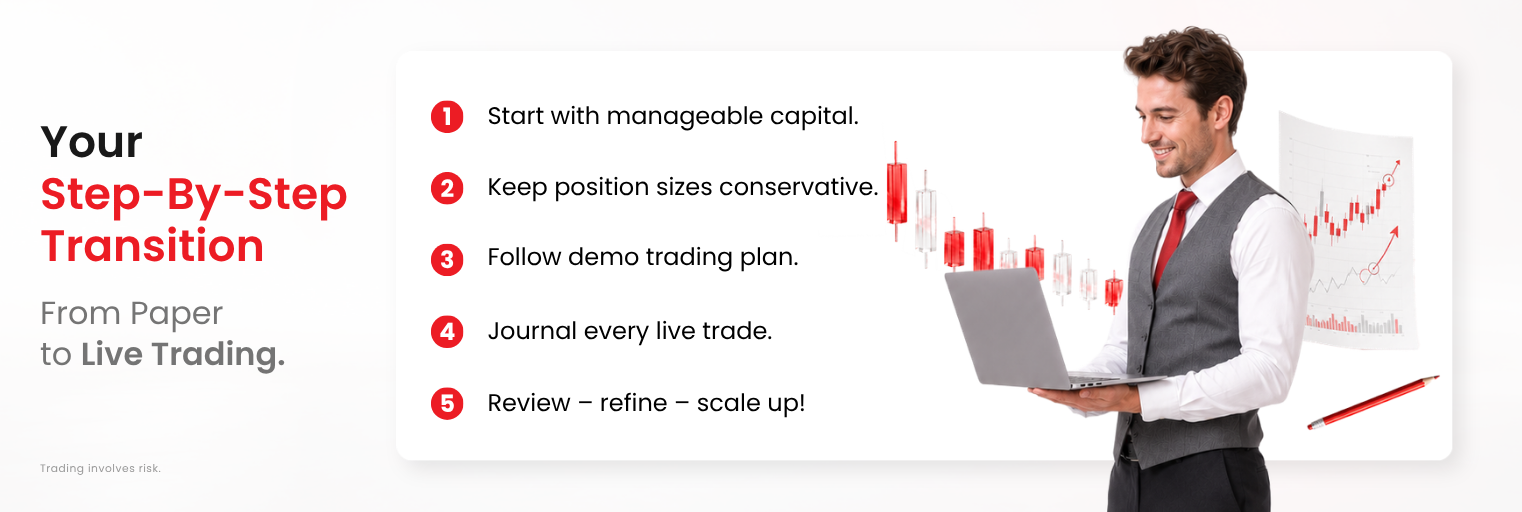
Start With Manageable Capital
Only commit an amount that fits your financial circumstances and risk tolerance.
The objective of your first live trades should not be to recreate your biggest demo wins. Rather than that, it should be to experience the difference between simulated and live conditions while keeping your exposure controlled.
Keep Your Position Sizes Conservative
Moving to a live account does not mean you need to trade bigger.
Starting with smaller position sizes can help you experience live execution and real market exposure without immediately taking on more risk than your plan allows.
Keep Following Your Demo Trading Plan
Do not throw away your process just because the money is now real.
Use the same entry criteria, risk limits, and decision-making framework you practiced in your demo trading phase.
The goal is to see whether the habits you built in paper trading can survive the emotional pressure of live trading.
Journal Every Live Trade
Your first live trades can teach you things a simulator cannot.
Record the entry and exit, your reasoning, execution conditions, emotions, and whether you followed your plan. Then compare those trades with your demo experience.
- Where did your behavior change?
- Did you hesitate more?
- Did you exit too early?
- Did your strategy perform differently after actual trading costs?
Those differences are indeed valuable information for your next trades.
Review Before You Scale
Do not increase your exposure simply because a few trades went well. Review your results, your behavior, and your risk management first.
Any increase in position size should fit within the trading framework you have already established. If you ask yourself, “what is paper trading really meant to teach me?”, the answer is discipline, which is exactly why protecting this framework as you scale is so crucial.
D Prime: Built for a Seamless Transition
We know each step takes time and effort, and the whole transition can be difficult for novice traders to navigate alone. This is why we have prepared a suite of features, resources, and tools to help you properly prepare for the important upcoming shift.
Build Experience With a D Prime Demo Account
Not ready to put real capital behind your strategy yet? That is exactly what a demo account is for.
A D Prime demo account gives you a simulated environment where you can explore the platform and practice trading without using real funds. Through this environment, you can access popular markets, including Forex, Commodities and Precious Metals at D Prime.
You can also configure account preferences including leverage, account currency, and your initial virtual balance.
Here are 3 steps you can take to quickly set up a D Prime demo account with us:
- Step 1: Log in and go to Accounts.
- Step 2: Select Demo and choose your preferred account settings.
- Step 3: Confirm and receive your login credentials via your registered email.
With this trading simulator, you can start exploring the platform, testing your approach, and building familiarity before deciding whether live trading fits your next step.
Keep Building Your Trading Foundation With D Prime
Paper trading is most valuable when you use it to learn, not simply to chase a larger virtual balance. That is why your development should go beyond placing demo trades.
At D Prime, we provide educational resources designed to help traders strengthen their understanding of markets, platforms, and trading concepts as they progress.
Our primary goal is simple: to ensure you fully grasp how the markets operate, familiarize yourself with the necessary terminology, and feel prepared to execute your strategies across a wide variety of asset classes.
Our ecosystem includes:
- Trading Guides: Materials on Stocks, Forex, Commodities, Precious Metals, Crypto, and Indices to help you understand how different instruments work before deciding how they fit into your trading approach.
- eBooks Collection: Deep dives into core concepts surrounding market behavior, risk management, and strategy development. As they help turn individual concepts into a broader framework, these are especially useful for traders aiming at a more structured strategy behind their decisions.
- Interactive Video Tutorials: Visual tutorials designed to help you through account setup, platform navigation, and practical trading functions.
Explore D Prime Smartpicks CopyTrading as a Separate Trading Approach
Not every trader wants to manage every position independently.
For those interested in social trading, D Prime Smartpicks CopyTrading offers another way to participate in the markets by following selected strategy providers.
The platform brings Copy Trading and PAMM capabilities into one ecosystem, giving users access to different approaches while maintaining control over their own account settings.
Key features within D Prime Smartpicks CopyTrading include:
- Real-Time Trade Replication: When a selected strategy provider places a trade, the corresponding activity can be replicated to follower accounts according to the configured settings.
- Strategy Providers Comparison: Review historical performance, risk characteristics, and other available information before deciding which strategy providers may fit your preferences.
- Account Independence: Followers can adjust applicable risk settings or stop copying based on their own decisions.
However, it is crucial to acknowledge that D Prime Smartpicks CopyTrading is not a substitute for understanding risk, and past performance does not guarantee future results. It should be considered a separate trading approach rather than a shortcut around building your own knowledge.
Paper Trading Builds the Process. Live Trading Tests It.
All in all, while paper trading gives you room to learn the platform, test ideas, make mistakes, and build more disciplined habits without putting real capital behind every decision; live trading introduces what a simulator cannot fully recreate: Real financial exposure. Real execution conditions. Real trading costs. Real emotion.
That said, there is no need to rush your move into live trading before you are fully prepared. Take your time wisely to master the guidelines above before jumping into live trading environment. The goal of comparing paper trading vs live trading is to use your time in a demo environment to develop a process you understand before deciding whether you are ready to apply it with real capital.
Still learning? Keep practicing.
Ready to explore the next step? Start gradually and keep your risk framework front and center.
With a D Prime demo account, educational resources, and additional trading tools available as you progress, you can build your experience at your own pace.
Start your D Prime demo account today. Build your process. Move forward when you’re ready.
Risk Disclosure
Trading in Securities, Futures, contracts for difference (CFDs) and other financial products carries high risks due to the rapid and unpredictable fluctuation in the value and prices of these financial instruments. This unpredictability is due to the adverse and unpredictable market movements, geopolitical events, economic data releases, and other unforeseen circumstances. You may sustain substantial losses including losses exceeding your initial investment within a short period of time.
You are strongly advised to fully understand the nature and inherent risks of trading with the respective financial instrument before engaging in any transactions with D Prime. When you engage in transactions with us, you acknowledge that you are aware of and accept these risks.
Disclaimer
The information contained herein is provided for general informational and educational purposes only and does not constitute investment advice, financial advice, trading advice, a recommendation, or an offer or solicitation to buy or sell any financial instruments or engage in any trading strategy.
Trading in leveraged products such as contracts for difference (CFDs) involves a significant risk of loss and may not be suitable for all investors. Past performance is not indicative of future results. Any references to market trends, asset performance, price levels, or forward-looking statements reflect opinions or general market commentary as at the date of publication and are subject to change without notice.
This article does not take into account any individual investor’s objectives, financial situation, or risk tolerance. Readers should conduct their own independent research and seek professional advice before making any investment or trading decisions. D Prime and its affiliates make no representations or warranties about the accuracy or completeness or reliability of this information and disclaim any and all liability for any direct, indirect, incidental, consequential, or other losses or damages arising out of or in connection with the use of or reliance on any information contained herein. The above information should not be used or considered as the basis for any trading decisions or as an invitation to engage in any transaction. Do not rely on this article to replace your independent judgment.
“D Prime” is a brand name of D Prime Vanuatu Limited, a company incorporated and regulated by the Vanuatu Financial Services Commission (Company Number: 700238). The availability of products and services may vary depending on jurisdiction and applicable regulatory requirements.