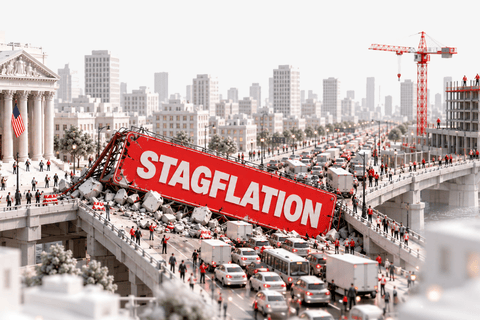


Gold fell below USD 4,000 and the Nasdaq slipped under 26,000. Is a broad bear market starting, or is expensive capital exposing the weakest links?
- Gold Falls Below USD 4,000: Why Markets Are Repricing Risk
- This Is Not a Broad Bear Market Yet
- Why Did Gold Fall Even as Inflation Rose?
- AI Spending Is Still Booming, but Financing Is the Problem
- Do the Midterms and Global Growth Point to a Bear Market?
- Fed Holds as Microsoft, Alphabet and Amazon Test the AI Trade
- What Should Gold and Stock Traders Watch Next?
- The Market Is Saying: Show Me the Returns

Gold Falls Below USD 4,000: Why Markets Are Repricing Risk
Gold broke below USD 4,000. The Nasdaq slipped under 26,000. AI credit worries are spreading.
On the surface, it looks like everything is starting to break at once. Spot gold slipped below USD 4,000 on October 23 for the first time since July, trading near USD 3,996 late in the US session, according to 24/7 Wall St. The Nasdaq Composite closed the same day at 25,955, a day after its steepest drop since June as worries over AI spending hit technology stocks.
Inflation is running hotter. Real yields remain high. AI companies are spending hundreds of billions of dollars on infrastructure. And the US midterm elections on November 3 are adding another layer of policy uncertainty.
So has a broad bear market arrived? There is one problem with that conclusion.
On October 23, the S&P 500 was still only 2.5% below its October 6 record high and up 11.4% for the year. The Nasdaq was also still up 11.7% year to date, according to Associated Press data.
That does not look like a broad bear market. It looks more like this: expensive capital is forcing markets to identify the weakest links first.
This Is Not a Broad Bear Market Yet
Recent price action has deteriorated, but scale matters.
A Correction, Not a Collapse
The S&P 500 closed at 7,623.68 on October 23, against a record close of 7,818.93 on October 6. The Nasdaq had fallen about 3.4% in October but was still firmly positive for 2026.
A bear market is conventionally defined as a fall of 20% or more from a recent high, and stocks have since steadied. By October 28, the S&P 500 had recovered to 7,743.98 and the Nasdaq was back above 26,000 at 26,549.85.
Why the Selloff Is Selective
Energy stocks have benefited from higher oil prices and cash-generative companies have held up better, while assets that depend on liquidity, distant future earnings or cheap capital have come under greater pressure.
The market is not saying growth is collapsing. It is saying: capital is expensive again. Show me the cash flow.
That is the same higher-for-longer pressure D Prime has been tracking throughout Q4. In our Q4 2026 Market Outlook: 4 Key Signals Traders Watch, we highlighted Treasury yields, inflation and the AI investment cycle as forces pulling markets in opposite directions. Gold is one of the clearest examples.
Why Did Gold Fall Even as Inflation Rose?
At first, gold’s decline looks counterintuitive. September US CPI accelerated to 3.7% year over year, while producer prices jumped 1.3% month over month, as D Prime examined in US Inflation Surges: Is Stagflation the Next Market Risk? Traditionally, higher inflation should strengthen demand for an inflation hedge like gold.
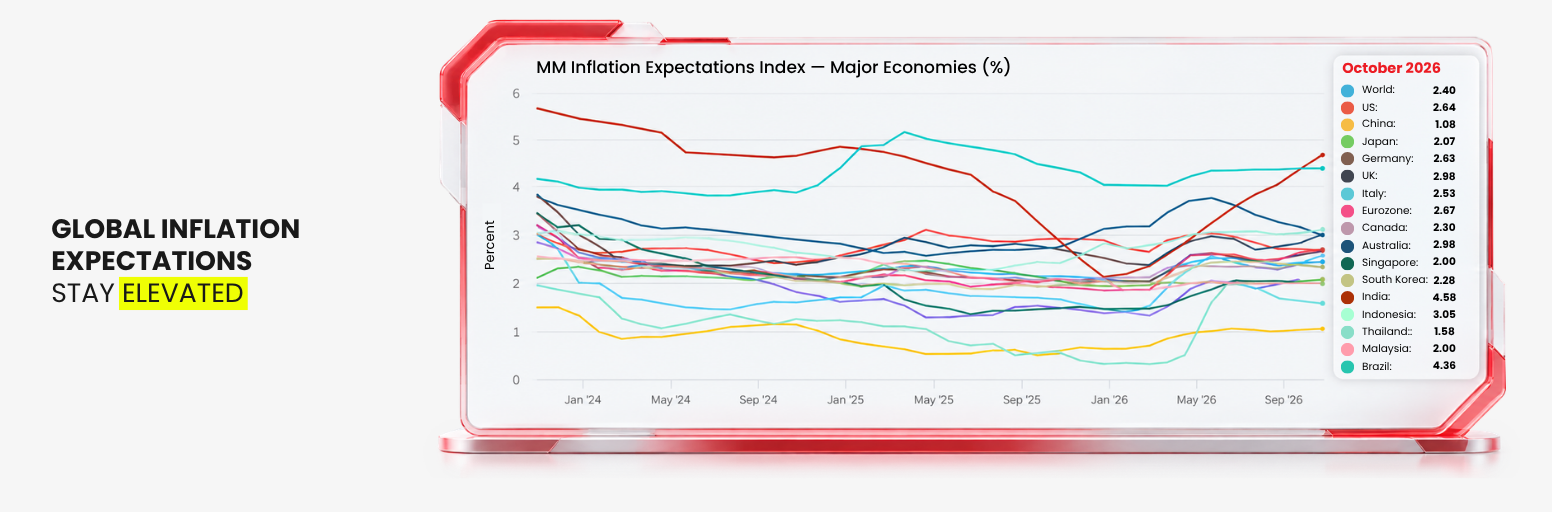
And the concern is not limited to the US. Market-based inflation expectations remain elevated across several major economies, reinforcing the view that persistent price pressure is becoming a broader global issue.
Real Yields Are the Other Half of the Story
The other half of the story is real interest rates.
Gold generates no cash yield. When inflation-adjusted Treasury yields become more attractive, investors face a higher opportunity cost for holding bullion. On October 23, the US 10-year inflation-protected Treasury yield stood at around 2.66%, according to US Treasury data. That remains exceptionally high compared with the environment that supported gold and other liquidity-sensitive assets earlier in the cycle.
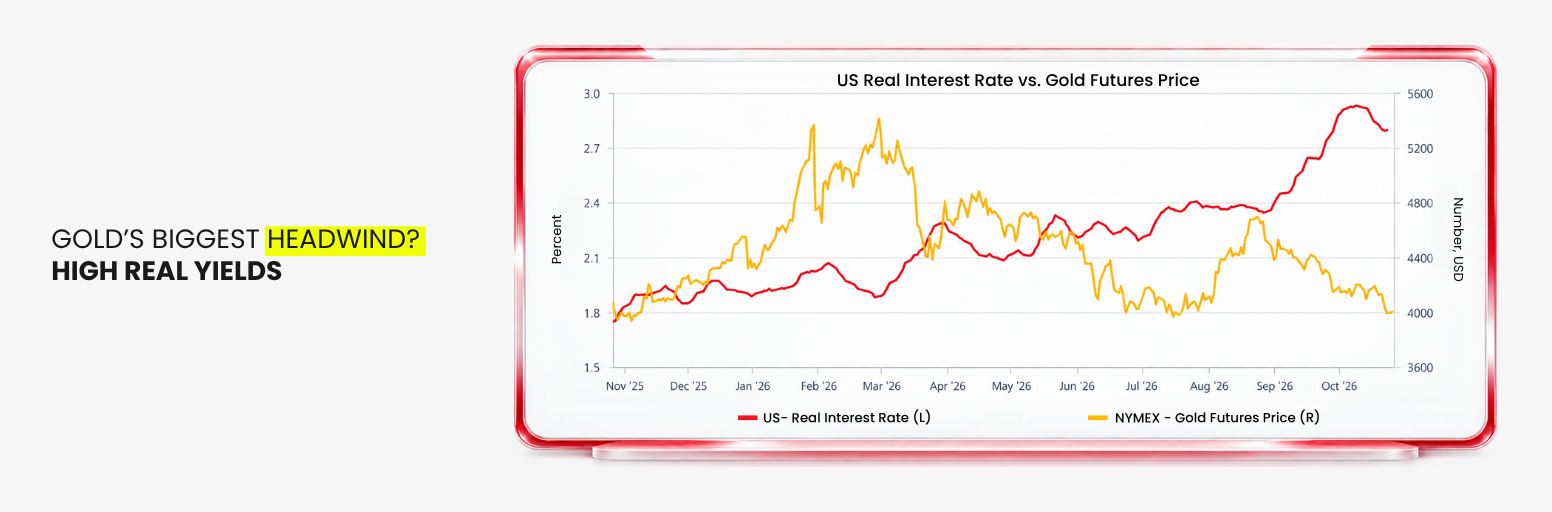
Gold is not falling because inflation disappeared. It is falling because the return available on inflation-protected US debt has become much harder to ignore.
Rising oil prices added to the pressure by lifting rate-hike expectations, and forced selling after the tech rout pushed some investors to raise cash from liquid assets such as gold and silver. We looked at how this rate regime feeds through to gold, the dollar and equities in Fed, ECB and BOJ Hike Rates: Is Higher for Longer the New Global Regime?
Long-Duration Assets Feel It First
Crypto valuations remain highly sensitive to liquidity and speculative risk appetite. Stocks generate earnings and cash flow, but higher yields increase the discount rate used to value those future earnings, and the farther those profits lie in the future, the more sensitive the valuation becomes.
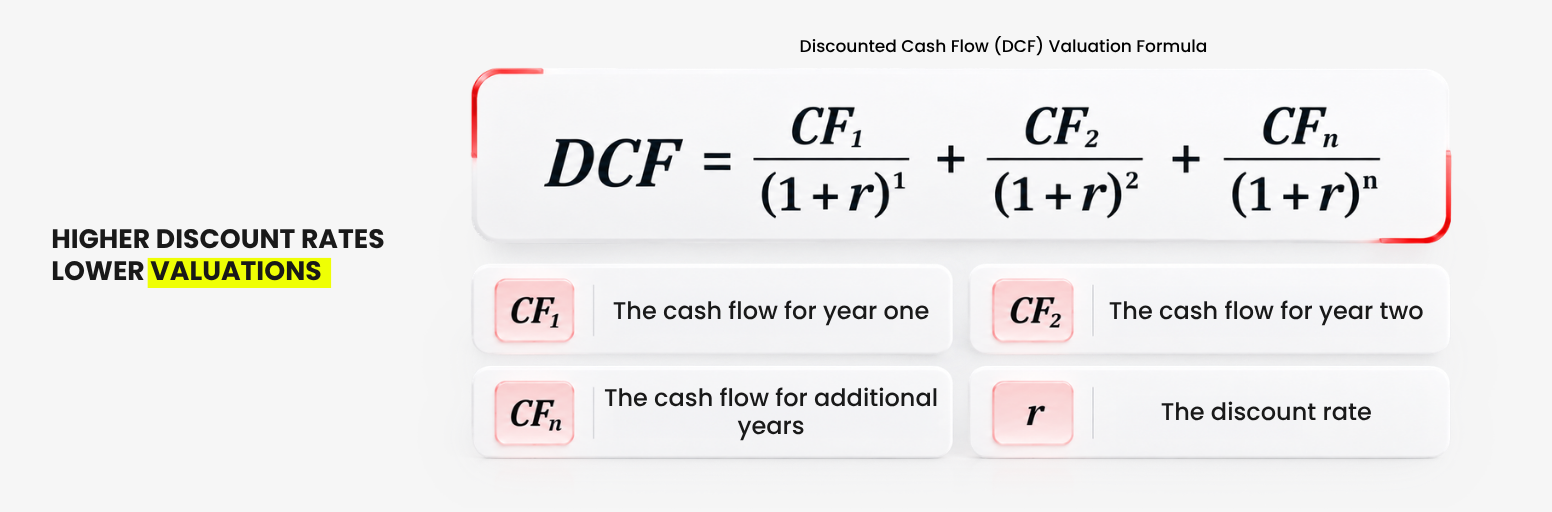
That is why long-duration growth assets tend to feel the pressure first, a pattern we traced back to the bond market in US Treasury Yields Stay High: Is a Debt Crisis Coming? And nowhere is that tension more visible than in AI.
AI Spending Is Still Booming, but Financing Is the Problem
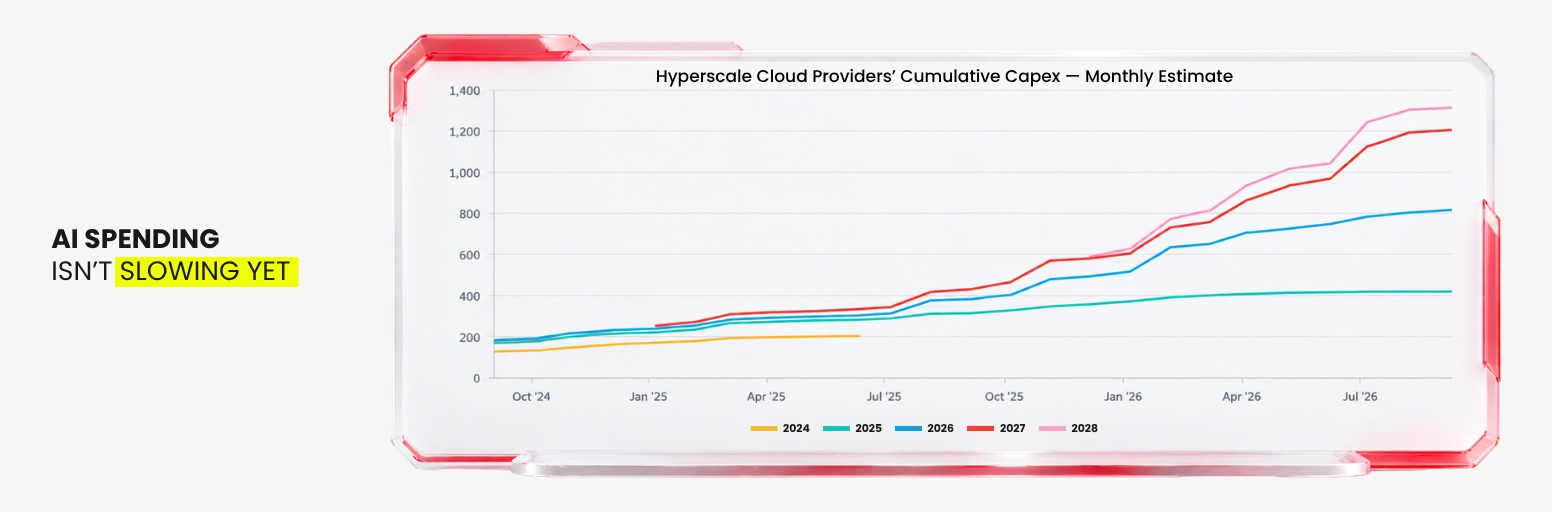
The recent technology selloff has created a new narrative: AI spending is slowing. The evidence does not support that conclusion yet.
The Capex Cycle Is Still Intact
TSMC kept its 2026 capital budget at USD 60 billion to USD 64 billion on October 15, said demand for its advanced processes is expected to stay strong, and said it will spend more on capex from 2026 to 2028 than in the previous three years. Meta, meanwhile, raised its 2026 capital spending forecast to USD 135 billion to USD 145 billion, even as its shares fell nearly 7%.
Even Microsoft’s lower reported capex figure of about USD 175 billion for 2026 reflected accounting changes, not a cut to its underlying investment plan, as management explained on its July earnings call.
This reinforces the conclusion from OpenAI Revenue Scare: Is the AI Chip Boom Really Slowing?: AI demand is not disappearing. Expectations are simply becoming harder to satisfy. Our DXpert column makes a similar point in AI Investing Explained: Opportunities, Risks and What Drives AI Stocks: AI succeeding as a technology does not mean every AI-related investment will succeed.
CoreWeave Shows Where the Risk Is
CoreWeave may be the clearest example of this new phase. At the end of Q2, the company reported approximately USD 104 billion in revenue backlog, before adding more than USD 25 billion of new customer commitments early in Q3. The demand is real.
So is the financing burden. CoreWeave carried about USD 35 billion of debt as of June 30, according to its quarterly filing. In August, it closed a USD 2.6 billion delayed-draw term loan to finance GPU servers and related infrastructure, priced at 5.5 percentage points over SOFR, wider than initially marketed. In September, it completed an upsized USD 4.2 billion convertible note offering carrying a 2.875% coupon.
That creates an unusual contradiction. CoreWeave has enormous contracted demand, and it also needs enormous amounts of external capital to deliver the infrastructure those contracts require. The risk is not that customers suddenly disappeared. It is that the economics become less attractive as financing costs rise.
The AI Trade Is Becoming a Credit Story
Building the AI economy requires vast upfront spending on GPUs, servers, networking, power, cooling, land and data centers. Many of those investments generate returns over years, while the financing costs begin immediately. As long as capital is cheap and growth is accelerating, that mismatch is manageable. When Treasury yields are around 5% and private financing costs are considerably higher, the hurdle rises.
This does not mean the AI cycle is ending. It means weaker balance sheets become much easier to identify. The strongest companies can fund infrastructure from operating cash flow, while others depend far more on debt, leases, private credit or repeated capital-market access.
Anthropic provides the next major test. The company publicly filed its S-1 registration statement on October 26 for a planned Nasdaq listing, saying proceeds are intended for general corporate purposes, including working capital, operating expenses and capital expenditures, as well as investment in compute and infrastructure. The public market may soon get another direct answer to the question investors are already asking across the sector: how much are they willing to pay today for growth that requires enormous capital investment tomorrow?
Do the Midterms and Global Growth Point to a Bear Market?
AI financing is not the only uncertainty facing markets, but neither the election calendar nor the global economy points to a broad collapse.
Midterms Add Volatility, Not Direction
The US midterm elections on November 3 will decide all 435 House seats and roughly one-third of the Senate. As we set out in our stagflation analysis, the channels that matter for markets are fiscal policy, regulation around AI, data centers and energy, and the outlook for government borrowing.
A change in congressional control does not automatically mean stocks rise or fall. The midterms are best viewed as a volatility amplifier, not the main cause of the current selloff. The more important forces remain inflation, real yields and the cost of capital.
The Global Economy Is Still Growing
The IMF’s October World Economic Outlook still projects 3.1% global growth in 2026 and 3.4% in 2027, with global headline inflation expected to reach 4.7% this year before easing to 4.1% next year. The IMF credits advanced economies and AI investment for that resilience, while warning that high energy prices threaten energy importers.
That combination is uncomfortable, but it is not a global recession. Growth is becoming more concentrated, and expensive capital is separating stronger business models from weaker ones, which is a very different environment from a bear market driven by collapsing earnings.
Fed Holds as Microsoft, Alphabet and Amazon Test the AI Trade
The Fed Holds, but December Stays Live
The Fed held its target range at 3.75% to 4% on October 28, but the vote was split 10 to 2, with Governor Lisa Cook and Cleveland Fed President Beth Hammack dissenting in favor of a 25-basis-point hike. The statement said inflation remains elevated and that more information will help the Committee set policy.
Chair Kevin Warsh declined to pre-commit to December, telling his press conference he does not believe in forward guidance outside a crisis, and called the 2% inflation goal a hard target. He also disputed the idea that AI investment is insensitive to interest rates. After the decision, futures still priced around an 83% chance of a December hike, according to the CME FedWatch Tool.
For gold and growth stocks, that keeps the cost-of-capital problem alive: real yields can stay restrictive even without an immediate rate increase.
Microsoft, Alphabet and Amazon Report
Three of the biggest AI spenders reported at the end of October, and their results captured this argument.
Microsoft’s Azure revenue grew 48%, accelerating from 42% in the June quarter, while capital expenditure including finance leases came in at USD 45.2 billion, below forecasts. Its shares rose about 4% after hours.
Alphabet showed the other side. Google Cloud revenue more than doubled to USD 30.7 billion and its backlog reached USD 561 billion, but quarterly capex jumped to USD 51.4 billion and free cash flow fell to minus USD 9.1 billion. On its earnings call, management kept its 2026 capex range at USD 195 billion to USD 205 billion and said capex will rise significantly in 2027. Its shares fell about 10% after hours.
Amazon, reporting on October 29, landed in between. AWS revenue rose 39% to USD 46.0 billion, its fastest growth in nearly five years, but trailing free cash flow was an outflow of USD 42.4 billion and long-term debt reached USD 173.1 billion, up from USD 65.6 billion at the end of 2025. Its shares fell about 6% after hours.
Same AI boom, very different reactions. The market rewarded spending that is visibly turning into revenue and margins, and punished spending that is draining cash or adding debt.
What Should Gold and Stock Traders Watch Next?
The next few weeks will show whether this is a correction that runs its course or the start of something broader.
November 3: US Midterm Elections
Watch for any shift in fiscal expectations or Treasury issuance that pushes long-term yields higher.
November 6 and 10: October Jobs and CPI
The October jobs report on November 6 and October CPI on November 10 will shape expectations for the Fed’s December meeting. Another hot inflation print would reinforce the case for higher real yields.
Real Yields and AI Credit Conditions
Keep watching the 10-year TIPS yield. A sustained decline from around 2.66% would relieve some pressure on gold and long-duration valuations, while another move higher would reinforce the current repricing.
Finally, watch credit rather than just stock prices. CoreWeave financing costs, data-center debt issuance, private-credit spreads and the reception to Anthropic’s IPO may say more about the next phase of AI than another daily move in Nvidia. The demand is still there; the question is how expensive it becomes to fund.
The Market Is Saying: Show Me the Returns
This is not yet a market where everything is breaking. It is a market where expensive capital is forcing investors to distinguish between growth that produces cash and growth that depends on continuously available financing.
What Has Changed for Gold and AI Stocks
Gold below USD 4,000, high real yields and widening concern about AI financing all matter. But none of these signals on its own prove that the entire market has entered a structural bear phase. The better interpretation is that the tolerance for weak economics is disappearing.
When money was cheap, the market could focus primarily on growth. Now the questions are tougher: how much debt a company carries, how much free cash flow it generates, and how quickly capital expenditure turns into revenue.
The Rules Have Changed
Gold is being tested by high real yields, AI infrastructure by funding costs and growth stocks by higher discount rates, with weaker balance sheets tested first. For much of the AI cycle, the market rewarded spending because spending itself signaled future growth. Their October earnings showed it now wants evidence that the spending can generate returns.
The market is not saying the boom is over. It is saying: show me the returns.
By D Prime Analysis Team
Macro and market strategy research by D Prime’s in-house analysis team.
Disclaimer
The information contained herein is provided for general informational and educational purposes only and does not constitute investment advice, financial advice, trading advice or any other form of professional advice, a recommendation, or an offer or solicitation to buy or sell any financial instruments or engage in any trading strategy.
Trading in leveraged products such as contracts for difference (CFDs) involves a significant risk of loss and may not be suitable for all investors. Past performance is not indicative of future results. Any references to market trends, asset performance, price levels, or forward-looking statements reflect opinions or general market commentary as at the date of publication and are subject to change without notice. Such statements are not guarantees of future performance or outcomes, may not materialise, and actual results may differ materially from those anticipated.
This article does not take into account any individual investor’s objectives, financial situation, or risk tolerance. Readers should conduct their own independent research and seek professional advice before making any investment or trading decisions. D Prime and its affiliates make no representations or warranties about the accuracy or completeness or reliability of this information and disclaim any and all liability for any direct, indirect, incidental, consequential, or other losses or damages arising out of or in connection with the use of or reliance on any information contained herein. The above information should not be used or considered as the basis for any trading decisions or as an invitation to engage in any transaction. Do not rely on this article to replace your independent judgment.
“D Prime” is a brand name of D Prime Vanuatu Limited, a company incorporated and regulated by the Vanuatu Financial Services Commission (Company Number: 700238). The availability of products and services may vary depending on jurisdiction and applicable regulatory requirements.